
The P-Fin 8 Financial Literacy Quiz: How Do You Compare?
How financially literate are you — measured against the whole country? The P-Fin 8 Index is an eight-question measure of financial literacy developed by the TIAA Institute and Stanford's Global Financial Literacy Excellence Center (GFLEC), released as a publicly available instrument so organizations and individuals can benchmark against national survey results. Each question comes from one of eight areas of everyday personal finance: earning, consuming, saving, investing, borrowing, insuring, comprehending risk, and choosing information sources.
The sobering context: U.S. adults answer only about 46% of these eight questions correctly, on average, and roughly a third get two or fewer right. Only 15% score seven or eight. Take it honestly — “Don't know” is an answer, and a useful one.
The quiz
1. Mark's salary has increased over the past two years. What would be a plausible reason for this?
- A. The number of workers with Mark's skills increased where he lives and works
- B. New technology reduced the demand for workers with Mark's skills
- C. Mark completed several training courses at a local college
- D. Don't know
2. A household budget cannot be used for which of the following?
- A. To track household financial assets
- B. To plan for necessary household expenses
- C. To plan household discretionary spending
- D. Don't know
3. Akiko has $1,000 in savings that earns a 2% rate of return over the course of the year. The inflation rate during the year is 3%. Which statement is true?
- A. She can afford to buy fewer things at the end of the year
- B. She can afford to buy more things at the end of the year
- C. It's not clear whether she can afford to buy more things or fewer things at the end of the year
- D. Don't know
4. Which statement about investing is correct?
- A. Investing in the stock of a single company is typically safer than investing in a mutual fund that holds shares of many companies in multiple industries
- B. Investing in a mutual fund that holds shares of many companies in multiple industries is typically safer than investing in the stock of a single company
- C. Investing in the stock of a single company and investing in a mutual fund that holds shares of many companies in multiple industries are typically equally safe
- D. Don't know
5. José owes $1,000 on a loan that has an interest rate of 20% per year compounded annually. If he makes no payments on the loan, at this interest rate, how many years will it take for the amount he owes to double?
- A. Less than 5 years
- B. 5 to 10 years
- C. More than 10 years
- D. Don't know
6. Katherine is a single 25-year-old worker who is in good health. What type of insurance coverage is she most likely to need in the near term?
- A. Life insurance
- B. Disability insurance
- C. Long-term care insurance
- D. Don't know
7. Lottery A pays a prize of $200 and the chance of winning is 5%. Lottery B pays a prize of $90,000 and the chance of winning is 0.01%. Expected winnings are greater in which lottery?
- A. Lottery A
- B. Lottery B
- C. They are equal
- D. Don't know
8. Which of the following appears to be inappropriate investment advice for the respective individual?
- A. A stock index fund to a 30-year-old worker saving for retirement
- B. A bond fund to a 60-year-old worker for some of her retirement savings
- C. A stock fund that invests in small start-up businesses to a 75-year-old retiree
- D. Don't know
Answer key and how the country did
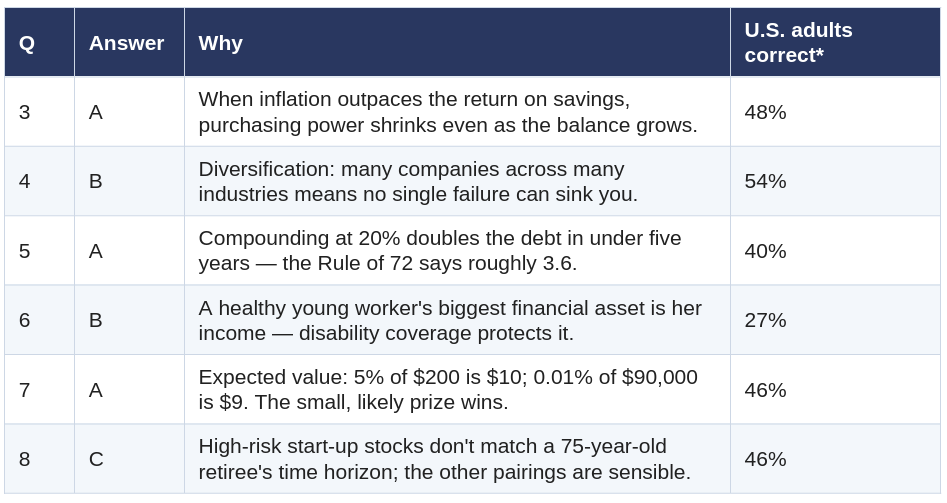
Scoring yourself
- 7–8 correct — very strong. Only about 15% of U.S. adults score here. Your work is applying what you know, consistently.
- 5–6 correct — above average. About 24% of adults land here; you're ahead of most, with specific gaps worth closing.
- 3–4 correct — national territory. Roughly the national average (46% of questions). Every miss is a fixable gap, not a verdict.
- 0–2 correct — you're not alone. About 36% of adults score here. It also means the highest payoff: a little knowledge here changes real outcomes.
Research behind this index consistently finds that financial literacy is strongly linked to financial well-being — people with very low scores are several times more likely to struggle to make ends meet, to be financially fragile, and to lack even one month of emergency savings. The knowledge is learnable, and every question you missed maps to a page in our resource library: budgeting and net worth, compounding, time in the market, safety nets and insurance, and investing terms.
The P-Fin 8 Index was developed by the TIAA Institute and the Global Financial Literacy Excellence Center (GFLEC) and released as a publicly available measure of financial literacy. Questions and national results: TIAA Institute–GFLEC Personal Finance Index. Presented here for educational purposes with attribution.

Want to turn your score into a plan? IPM Advisory can walk through your misses, connect each one to the right resource, and build the fundamentals into your financial plan.

